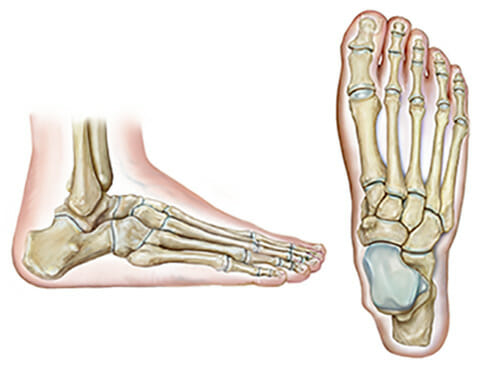
Your foot has 26 bones. They help support your weight as you walk, run and go about your day. Sudden pressure or overuse of these bones can cause a bone to break. Foot fractures often happen in your toes and in the bones on the top of your foot. You can also have a fracture in your ankle or heel.
- A mild fracture might be a small break in one bone. You may still be able to walk.
- A serious fracture could break several bones and need surgery. These injuries can make it hard to walk, drive or go to work.
Foot fractures are different than ankle sprains. A sprain happens when the tissues that hold bones together are stretched or torn. You can have both a break and a sprain at the same time, but they are treated differently.
Foot and ankle experts at Summit Orthopedics locations in the Minneapolis/St. Paul area diagnose and treat ankle and foot fractures with the highest level of care. Our goal is to relieve your symptoms, restore normal foot functioning and reduce the risk of further complications as quickly as possible.
Types of Ankle and Foot Fractures
Foot fractures have different levels of severity. Generally, fractures are categorized by how much the broken bones have moved out of place.
Nondisplaced Fracture
In this type of fracture, the bones are still in the correct position. The bone is broken, but the pieces have not moved apart. This type of fracture usually does not need surgery and can often heal with a cast or boot.
Displaced Fracture
In a displaced fracture, the broken pieces of bone have moved out of place. There may be breaks in one or more parts of your ankle. Sometimes, the ankle joint is also dislocated or out of position. These types of injuries usually need surgery to fix.
Open Fracture
An open fracture occurs when the broken bone breaks through the skin. It is a very serious medical emergency that must be treated with surgery immediately. When the skin is open, germs and dirt can get into the wound, causing an infection.
Stress Fracture
A stress fracture is a small crack or deep bruise in a bone. These injuries usually happen from repetitive activities like running, which is why stress fractures are common in runners and athletes.
Symptoms of Ankle and Foot Fractures
Foot fractures can happen after twisting an ankle, falling from a height or during repetitive movements like running.
If you think you have a broken ankle or foot, watch for these signs:
- Blisters that appear near the injured area
- Bone that sticks out through the skin
- Sudden and strong pain when you touch or move the foot or ankle
- Swelling and bruising on the foot or ankle
- The foot or ankle looks out of place or different from how it usually does
- Trouble walking or putting weight on your foot or ankle
Diagnosing Ankle or Foot Fractures
After a suspected foot or ankle injury, your doctor needs to evaluate your symptoms quickly. Diagnosing a fracture involves a physical examination and imaging tests, like X-rays, CT scans and MRI. Sometimes, imaging tests can help doctors see if you damaged or tore a ligament or tendon when you broke your foot or ankle.
- CT scan: A CT scan gives detailed cross-sectional images of the ankle and is used to evaluate the extent of injury, especially damage to the ankle joint.
- MRI: MRI scans show high-resolution images of bones and soft tissue structures, like ligaments. They’re often used to find associated ligament injuries.
- X-rays: These are the main diagnostic tool for most foot and ankle fractures. They show where the bones are broken and if any bone fragments are out of place.
Nonsurgical Treatment
Many ankle and foot fractures, especially nondisplaced fractures, do not require surgery. Broken bones in the feet take about six to 12 weeks to heal. During this time, your doctor will likely recommend that you not use (immobilize) your foot. They’ll also suggest taking medication to relieve symptoms.
- Immobilization: A short leg cast or walking boot protects the ankle and foot, allowing the broken bone to heal. Whether or not you can put weight on your foot right away depends on how severe the fracture is. Some fractures are stable enough that you can walk on them in a boot, but others need a period of time where you can’t put any weight on your foot at all.
- Medication: Your doctor may prescribe pain or anti-inflammatory medications. Over-the-counter options like acetaminophen can also help.
Surgery
Surgery is the usual treatment for displaced fractures, unstable fractures or injuries involving a lot of soft tissue injury. Surgical repair is often the best way to properly realign the bone, secure it in place and fix any torn ligaments or muscles.
Recovery
After surgery, your doctor will monitor you for the first six weeks. They will order X-rays to see how your fracture is healing. Your doctor will tell you when it’s safe to put weight on your ankle and may refer you to a physical therapist. Physical therapy is an important part of your recovery.
It is important to follow your doctor’s instructions. Putting weight on the injured ankle too soon can cause the bone fragments to shift and slow your recovery. Most people return to normal activities within three to four months, though complete recovery for complex ankle fractures can take up to two years.
Expert Care for Ankle and Foot Fractures at Summit Orthopedics
Foot and ankle fractures require expert care to ensure the best possible recovery.
Our team specializes in diagnosing and treating broken bones with precision. We carefully locate the fracture, determine its severity and create a personalized treatment plan to support the best possible outcome.
If surgery is needed, our fellowship-trained surgeons use minimally invasive techniques whenever possible to help reduce pain, lower the risk of complications, and speed up recovery.
Summit Orthopedics surgeons are available at nearly 30 convenient locations across the Minneapolis/St. Paul metro area, serving Minnesota and western Wisconsin. Our state-of-the-art, comprehensive orthopedic centers offer same-day appointments from a team of experts who offer the full scope of orthopedic care.
Find your Summit Orthopedics foot and ankle expert, request an appointment or call us at (651) 968-5201 to schedule a consultation.