Dupuytren’s Contracture Treatments
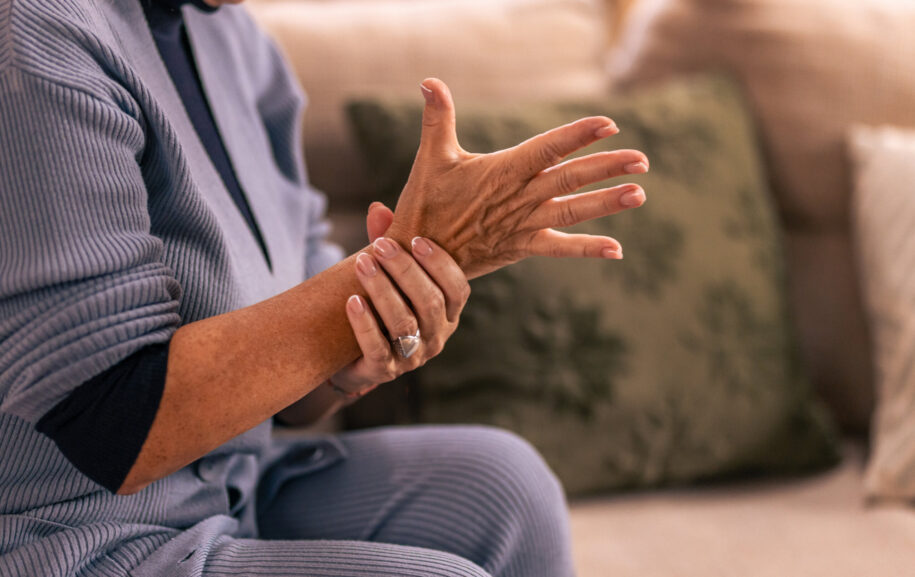
If you have a hard time spreading your fingers apart and one or more of them bend toward your palm, you may have Dupuytren’s contracture. The condition, also known as Dupuytren’s disease, causes stiffness in the hand, typically affecting the small and ring fingers. While symptoms normally develop slowly, it’s important to seek Dupuytren’s contracture treatment as soon as possible.
“Dupuytren disease is a common hand diagnosis we see here in Minnesota,” says Dr. Michael Forseth, orthopedic hand specialist at Summit Orthopedics. “It’s easily treated, but the earlier we see it, the better. If it advances and causes significant contracture, it’s more difficult to treat.”
Keep reading to learn about Dupuytren’s contracture and how it’s treated.
Why Do My Fingers Curl? Understanding Dupuytren’s Contracture
Dupuytren’s contracture is a genetic condition that causes the muscles, ligaments and skin in your hand to tighten. Over time, the condition causes one or more fingers to curl down toward the palm. The condition is not dangerous, but it can become increasingly inconvenient as your hand function declines.
Risk factors include:
- Being of Northern European ancestry
- A family history of the condition
- A history of diabetes or seizure disorders
- Increasing age
- Sex (It’s more common and more severe in males)
Dupuytren’s Contracture Treatment Options
Currently, there is no cure for this condition. But left untreated, Dupuytren’s contracture can make it impossible to straighten your fingers over time. If multiple fingers are involved, you may lose function of the affected hand.
Proper treatment aims to reduce symptoms of Dupuytren’s contracture and restore or maintain hand function.
Nonsurgical Options for Dupuytren’s Disease
In the early stages of the disease, you may notice lumps or nodules in your palm. These lumps don’t always change or grow. If they don’t bother you or cause any significant symptoms, you don’t necessarily need treatment.
Over time, though, these nodules may thicken, developing into tight cords of tissue under the skin that can pull the fingers toward the palm, making it impossible to straighten them. When this occurs, treatment becomes necessary.
“Patients ask if Dupuytren’s can be treated without surgery,” Dr. Forseth says, “and there are a number of things we can do before it comes to surgery.”
Nonsurgical options include:
Enzyme Injections
Enzyme injections, also known as collagenase injections, use a special enzyme to break down thickened tissue and soften the cord, allowing the finger to be extended and straightened.
“The treatment is relatively easy and effective,” says Dr. Robert Anderson, orthopedic surgeon and hand specialist at Summit Orthopedics. “It eliminates the cord and the contracture, so your finger’s range of motion comes back.”
Hand Therapy
A physical therapist who specializes in hand therapy can teach you exercises to improve your hand’s strength and function. They can also show you ways to move your hands to reduce symptoms.
Needle Aponeurotomy
A needle aponeurotomy is an in-office procedure. Your orthopedic surgeon inserts a thin needle into the tissue causing your hand to contract. This creates small holes in the tissue. The surgeon then manually straightens your affected fingers, separating the diseased tissue and releasing its pull on your fingers.
Steroid Injections
Corticosteroids can reduce pain associated with Dupuytren’s disease. They can also soften the lumps and nodules that form in the condition’s early stages.
A Surgical Approach to Dupuytren’s Contracture Treatment
You may need surgery if your contracture progresses despite nonoperative treatments. Based on the severity of your condition, overall health and other factors, your surgical team will recommend an open surgical approach.
Fasciotomy
Your surgeon divides the thick tissue cords through one or more incisions in your palm. This loosens the cord and helps improve movement in the contracted fingers. Following surgery, the incision site is left open, and you wear a splint during recovery. The incisions heal slowly over time.
Partial Palmar Fasciectomy
In this procedure, your orthopedic surgeon removes as much damaged or abnormal tissue as possible through a series of incisions. Repeat contracture is less likely after this procedure, as the tight cords of tissue are removed. In less common cases, your surgeon will transfer healthy skin from another part of your body to your hand. This process, known as skin grafting, helps with wound healing and is used only when appropriate.