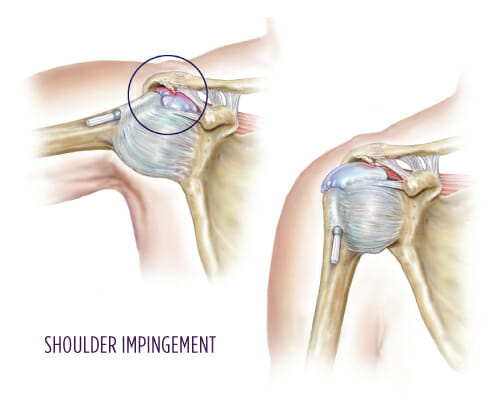
Shoulder impingement is caused by bones in your shoulder pinching the rotator cuff (a group of muscles and tendons that help the joint move). Also known as shoulder impingement syndrome, this condition causes pain and other symptoms and often occurs when you repeatedly raise your arm overhead, stressing your shoulder.
At Summit Orthopedics, our shoulder specialists in the Minneapolis/St. Paul area treat shoulder impingement with a personalized approach. Together, we’ll find the right combination of therapies to provide relief and help you feel like yourself again.
Types of Shoulder Impingement
The rotator cuff and bursa (a fluid-filled sac) sit in a tight spot between your upper arm bone and shoulder blade. When you lift your arm, this space gets even tighter. Normally, there’s still enough room. But if your shoulder is swollen, the bones can pinch the rotator cuff tendons, causing pain.
Doctors classify shoulder impingement by what gets pinched and how.
- Subacromial impingement. This is the most common type of shoulder impingement. It occurs when a tendon or the bursa is squeezed between the ball of the upper arm bone and the bone on top of the shoulder blade (known as the acromion).
- Subcoracoid impingement. This type of impingement happens when one of the rotator cuff tendons is squeezed between bony bumps on the shoulder blade and upper arm bone, near the front of your armpit.
- Internal shoulder impingement. This form of impingement happens when a rotator cuff tendon gets pinched between the ball of the upper arm bone and the rear of the shoulder socket.
What Does a Shoulder Impingement Feel Like?
Most people with a shoulder impingement develop pain in the joint. Your shoulder may ache or feel tender, usually in the front. The pain may also extend to the side of your arm, and you may have a limited range of motion.
Other symptoms of shoulder impingement include pain when:
- Lifting your arm
- Lying on the affected side
- Reaching overhead or behind
- Resting your arm
- Trying to sleep
You may be able to tell the difference between a shoulder impingement and a related injury, a rotator cuff tear, by whether your shoulder feels weak. Both conditions cause shoulder joint pain and reduce range of motion, but a rotator cuff tear is more likely to lead to weakness.
Shoulder Impingement Causes and Risk Factors
Irritation in the shoulder can lead to swelling, narrowing the already-tight space between the top of the upper arm bone and the shoulder blade. This swelling leads to pinching of the rotator cuff.
Most of the time, your shoulder swells slowly because you use it too much. Doing overhead movements that twist your shoulders repeatedly can irritate the joints. Sometimes, shoulder impingement can happen quickly from an injury, like falling.
You have a higher risk for shoulder impingement if you:
- Do work requiring heavy shoulder use or overhead movement, like construction or landscaping
- Have had a traumatic shoulder injury
- Play a sport involving frequent overhead or throwing movements, such as swimming or baseball
- Sit or stand with incorrect posture
How Is Shoulder Impingement Diagnosed?
Your doctor will ask about your symptoms, activities and medical history, and examine your shoulder. They may also order imaging tests to see the shoulder bones and soft tissues.
Medical History and Shoulder Exam
The doctor will ask you about your shoulder pain. They’ll want to know when it started, where it hurts most, and if certain movements or times make it worse. They’ll also ask about your job, sports and hobbies to see if you’re using your shoulder too much. Lastly, the doctor will ask if you’ve hurt your shoulder before.
Next, the doctor will examine your shoulder for pain or tenderness. They will ask you to move the joint (or they may gently move it) to check its strength and range of motion.
Imaging
Imaging tests can help your doctor diagnose shoulder impingement by revealing bone problems, soft tissue irritation or injuries. Your doctor may order:
- X-ray: Bones show up well in X-rays. Your doctor can use this test to look for bone spurs, which can contribute to pinching in the shoulder.
- MRI: MRIs use powerful magnets and radio waves to show soft tissues clearly. This test allows your doctor to see rotator cuff inflammation or tears.
- Ultrasound: You may not be able to have an MRI if you have a metal implant in your body. In that case, your doctor may order an ultrasound, which uses sound waves to show soft tissues.
Nonsurgical Treatment
Shoulder impingement doesn’t usually go away on its own. The longer you wait to treat it, the worse the shoulder pain can get. Fortunately, most people don’t need surgery to fix a shoulder impingement. Your doctor can recommend many nonsurgical treatments to relieve pain and help your shoulder heal.
- Cortisone injection: A shot of anti-inflammatory medicine in your shoulder can help calm irritation and swelling in the joint.
- Nonsteroidal anti-inflammatory drugs (NSAIDs): Common NSAIDs include aspirin and ibuprofen, which you can buy over the counter, to reduce pain.
- Orthobiologic (regenerative) injections: Injecting specific substances taken from your own body, such as platelet-rich plasma, can help fuel healing.
- Physical therapy: A physical therapist can show you stretches and exercises to strengthen your shoulder and help it move more naturally.
- Rest: Give your shoulder a break from activities that worsen symptoms, like swimming or painting.
Surgical Treatment
If nonsurgical treatments don’t help, you may need a shoulder arthroscopy (a surgery performed through small incisions using special surgical tools). This operation will create more space for your rotator cuff, relieving the pinching in the shoulder joint. Your doctor may perform two procedures during the same arthroscopy:
- A bursectomy to remove the irritated part of the bursa
- A subacromial decompression to take out any bone spurs on top of the shoulder blade
Recovering From Shoulder Impingement
Your shoulder should start to feel better a few weeks after you start treatment, but a complete recovery may take up to a year. Wait until your provider says it’s OK to do physical activities. Otherwise, you might use your shoulder too soon and injure it further.
If you have surgery, you may need to wear a sling for a few days or weeks afterward to keep your arm still while you heal. Once you stop wearing the sling, you’ll need to participate in physical therapy and perform shoulder exercises at home as directed by your doctor to continue your recovery.
Care for Shoulder Impingement at Summit Orthopedics
Shoulder impingement is one of the most common causes of shoulder pain, and at Summit Orthopedics, our team has the skills and experience to solve it. Our shoulder experts will guide you through a personalized treatment plan. Let us help you put shoulder pain in the past and move forward with a better-functioning joint.
Summit Orthopedics surgeons are available at nearly 30 convenient locations across the Minneapolis/St. Paul metro area, serving Minnesota and western Wisconsin. Our state-of-the-art, comprehensive orthopedic centers offer same-day appointments from a team of experts who offer the full scope of orthopedic care.
Find your Summit Orthopedics shoulder expert, request an appointment or call us at (651) 968-5201 to schedule a consultation.