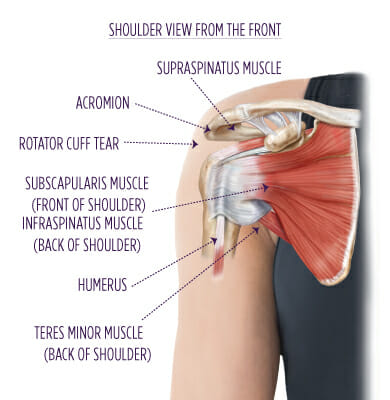
According to the American Academy of Orthopaedic Surgeons, nearly 2 million people visit a doctor each year because of a torn rotator cuff. While most people find relief from rotator cuff injuries with nonsurgical treatment, rotator cuff surgery is also an option.
A torn rotator cuff can be life-disrupting, causing severe shoulder pain, stiffness and weakness during everyday activities. If you experience a rotator cuff injury, you don’t have to simply live with the pain—turn to Summit Orthopedics for a diagnosis and treatment.
We offer the highest standard of care with both nonsurgical and surgical treatment for rotator cuff tears. Our orthopedic specialists in the Minneapolis/St. Paul area work with you to find the best treatment plan for your specific needs and symptoms.
What Is the Rotator Cuff?
The rotator cuff is a group of tendons and muscles stretching from your shoulder blade to your upper arm bone, roughly forming a cuff shape in the shoulder. These tendons and muscles stabilize your arm bone within the shoulder joint, giving your arm a full range of motion.
They do that in two ways: They start the shoulder’s movement when the arm moves away from the body and they pull the upper arm bone and shoulder together as the shoulder moves. Put more simply, the rotator cuff helps you lift and rotate your arm.
Early in life, the rotator cuff tendons and muscles are pliable and elastic, allowing them to stretch and easily bounce back after stretching. As you get older, they become less pliable, increasing the risk of a torn rotator cuff.
A rotator cuff tear occurs when one of the rotator cuff tendons, which connect the shoulder bone to the muscle, is damaged. Torn tendons can be either partial tears or full-thickness tears, depending on whether the tendon is detached from the bone.
Both types of rotator cuff tears can cause shoulder instability, weakness and pain. Partial tears often heal with nonsurgical treatment, but you may need rotator cuff surgery for severe tears.
What is Rotator Cuff Surgery?
Rotator cuff surgery, a type of shoulder surgery, may be recommended if:
- You have a full-thickness rotator cuff tear.
- You have experienced an acute injury resulting in a rotator cuff tear.
- You have tried nonsurgical treatment options without finding relief.
Rotator cuff surgery involves repairing the torn rotator cuff. When a rotator cuff tendon is fully detached from the bone, surgery reattaches it. When the rotator cuff is only partially torn and still attached to the bone, surgery trims or otherwise repairs the tendon.
Your provider can recommend a specific surgery based on the size, location and extent of the tear. There are two primary types of surgery to repair a torn rotator cuff:
Arthroscopic Repair
During an arthroscopic repair, also called arthroscopy, the rotator cuff and affected tendon are accessed through three small incisions in the front, side and back of the shoulder. A tiny camera and surgical instruments are then inserted through the incision.
Guided by a real-time view of the shoulder captured by the camera, a surgeon can visualize the rotator cuff tear and repair it.
Surgeons repair most rotator cuffs arthroscopically since this type of surgery uses smaller incisions and doesn’t require splitting or detaching the deltoid muscle to access the torn tendon.
Open Repair
During open rotator cuff repair surgery, the surgeon makes a larger incision over the shoulder. Once the shoulder is open, the surgeon detaches or splits the deltoid muscle to view and access the torn tendon in the rotator cuff.
The surgeon then repairs the torn tendon and may also remove bone spurs or damaged tissue.
What Can I Expect Before Surgery?
If an orthopedic specialist recommends you have rotator cuff surgery, you’ll first need to undergo presurgical testing to ensure you’re healthy enough to have surgery. Once you have the green light from your primary care provider to have surgery, you’ll receive a set of instructions to help you prepare.
These instructions outline details such as when to stop eating before the procedure, whether to discontinue any medications you’re taking and when to arrive at the surgical center or hospital on the day of surgery.
What Can I Expect on the Day of Surgery?
On the day of surgery, nurses on your treatment team check your vital signs and may perform other minor tests. You’ll also meet with an anesthesiologist to talk about anesthesia for your procedure. Surgeons usually perform rotator cuff surgery while patients are under general anesthesia.
Once these preliminary steps are complete, your surgeon or another member of the treatment team talks with you about any questions or concerns you have.
What Can I Expect After Surgery?
You’ll be moved to a recovery room immediately after surgery, where a nurse will carefully monitor you as you emerge from anesthesia. After a short time, you may be moved to another room in the facility or discharged home.
In most cases, rotator cuff surgery is a same-day procedure, meaning patients go home on the same day as surgery. Before you leave the hospital or surgical center, your treatment team walks you through what to expect as you recover at home, including how to identify the signs of potential complications.
Complications After Rotator Cuff Surgery
Rotator cuff surgery is widely considered safe and effective, but there’s some risk involved in any surgical procedure. Potential complications after rotator cuff surgery can include:
- Anesthesia complications
- Blood clots
- Deltoid detachment
- Excessive bleeding
- Infection
- Nerve injury
- Persistent shoulder stiffness
- Reflex sympathetic dystrophy, which causes severe, burning pain
- Tendon re-tear
It’s also possible to experience failure to heal following surgery or repair failure, where the surgery doesn’t successfully repair the rotator cuff.
How Long Does It Take to Recover After Rotator Cuff Surgery?
Most people fully recover from rotator cuff surgery within six months of surgery.
Following rotator cuff surgery, your arm and shoulder are immobilized in a sling for up to six weeks to allow the shoulder time to heal. At first, your care team may tell you not to remove the sling at any time, but after your first follow-up appointment, you may be able to remove it for short periods to shower and perform prescribed exercises.
As you recover, you’ll need to participate in physical therapy to strengthen your shoulder. In the first stage of rehabilitation, a physical therapist helps you perform passive exercises, supporting your shoulder as you work to improve the range of motion.
After a few weeks, you’ll begin performing active exercise, where you move your own shoulder and support its weight during activity. These exercises help you build strength and improve arm control to fully restore shoulder function.
Rotator Cuff Surgery at Summit Orthopedics
While most rotator cuff tears can be treated successfully using nonsurgical treatment options, surgery may be needed for severe tears and in certain other circumstances. At Summit Orthopedics, we can help you find the treatment option that works best for you, including both open and arthroscopic repair when needed.
Summit Orthopedics surgeons are available at nearly 30 convenient locations across the Minneapolis/St. Paul metro area, serving Minnesota and western Wisconsin. Our state-of-the-art, comprehensive orthopedic centers offer same-day appointments from a team of experts who offer the full scope of orthopedic care.
Find your Summit Orthopedics shoulder expert, request an appointment or call us at (651) 968-5201 to schedule a consultation.