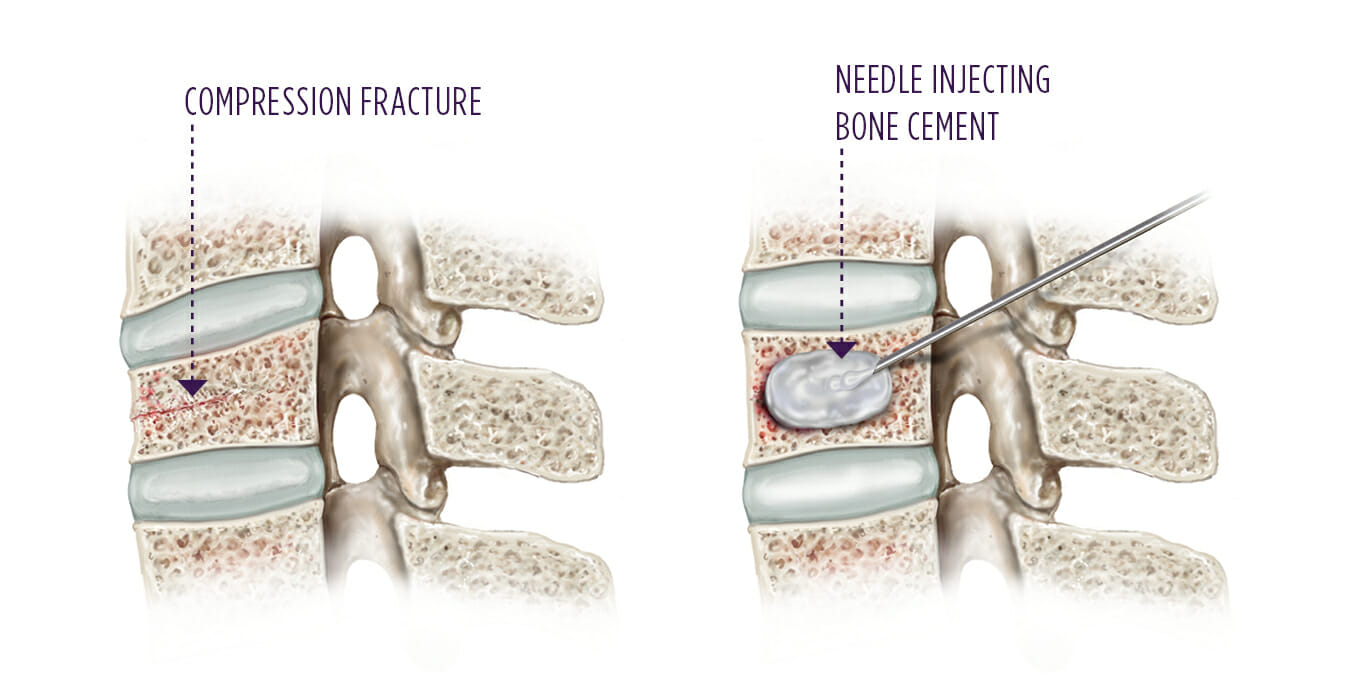
Vertebroplasty and kyphoplasty are types of minimally invasive spine surgery that treat spinal compression fractures. These procedures do not use big cuts. Instead, the spine surgeon sends a needle into your back and injects a special cement into the damaged bone. As the cement hardens, it holds the bone together and prevents further breakdown.
You will go home the same day as your procedure. Shoring up the bone with cement can relieve pain and help you move better.
Summit Orthopedics spine care experts in the Minneapolis/St. Paul area routinely perform vertebroplasty and kyphoplasty and can help you get back to your active life. If you’re ready to move on from back pain, our spine specialists can help you decide whether a procedure is right for you.
How You May Benefit From Vertebroplasty/Kyphoplasty
Unlike regular back surgery, vertebroplasty and kyphoplasty aren’t major surgeries with a long recovery time. Both are same-day procedures that don’t require much downtime. Most importantly, they can help you feel better and do the things you love.
- Better quality of life
- Improved ability to move around
- Less pain
- No big incisions
- No hospital stay
- No physical therapy after the procedure
Could Vertebroplasty/Kyphoplasty Be Right for You?
You may need a vertebroplasty or kyphoplasty if you have a compression fracture in your spine. This injury is a break in one of the vertebrae, the bones that make up your spine. Several conditions, including osteoporosis and cancer, can cause compression fractures.
You may feel better by resting, taking medicine or going to physical therapy. Those treatments don’t work for everyone, though. If your pain is very bad or doesn’t improve with other treatments, vertebroplasty/kyphoplasty may be a good option for you.
Vertebroplasty vs. Kyphoplasty
A spine specialist can help you choose between vertebroplasty and kyphoplasty. Both procedures treat spinal compression fractures and involve sending cement into the bone through a needle. With kyphoplasty, though, the surgeon inflates a small balloon inside the fractured vertebrae to create space. Then, they fill the space with cement.
What to Expect
Follow your spine surgeon’s instructions to prepare for a vertebroplasty or kyphoplasty. The length of the procedure depends on how many bones need treatment. Each bone takes about an hour to treat. You will go home after the procedure and should spend the next day or two resting. Then, you can get back to most normal activities.
Preparing for Your Procedure
- Ask a friend or family member to drive you to and from the procedure.
- Follow your surgeon’s instructions to stop eating or drinking before your procedure if you will receive local or general anesthesia.
- Inform your care team if you have a pacemaker.
- Tell your care team about the medicines you take. Your surgeon may tell you to stop taking certain medicines before the procedure.
- Tell your care team if you feel sick before the procedure so they can reschedule it, if necessary.
During the Procedure
Before the procedure starts, a member of the operating team will place an intravenous (IV) line in your arm. The team may deliver medicine or fluids through the IV during the procedure. You will lie face down on an X-ray table. The operating team will clean the area where the needle will go into your skin. Then, you may receive medicine to help you relax.
The procedures typically follow these steps:
- The surgeon will use a special type of X-ray imaging called fluoroscopy to view the fracture and guide the needle to it.
- Next, they will send the needle to the fracture.
- If you’re having kyphoplasty, they’ll then inflate a small balloon to create a cavity inside the damaged vertebrae.
After the Procedure
You will lie flat for one hour while the cement hardens. Afterward, you’ll be free to go home.
Vertebroplasty/Kyphoplasty Risks
Vertebroplasty and kyphoplasty are safe and effective procedures. Like any procedure, though, they can cause complications. The most common complication is cement leakage into nearby areas of the spine. Cement leakage can affect the nerves and cause other problems.
Additional complications may include:
- Allergic reaction
- Bleeding
- Blood clots
- Damage to nearby spinal bones
- Infection
- Nerve injury in the spinal cord
- Pain at the injection site
Recovering From Vertebroplasty/Kyphoplasty
Full recovery can take six weeks, but you’ll feel better much sooner. You may notice less back pain right away or within 48 hours after the procedure.
Once you go home, rest for 24 to 48 hours. Don’t soak in a tub for 24 hours after the procedure. After resting, you can resume most regular activities. Avoid heavy lifting and vigorous activities for six weeks.
You can take the bandage off your wound the day after the procedure. Be sure to keep the site clean and dry. Watch for symptoms of infection, such as pain, swelling or redness at the injection site. If you notice unusual symptoms, contact your surgeon’s office.
Vertebroplasty/Kyphoplasty at Summit Orthopedics
At Summit Orthopedics, we put you at the center of care, which is why we’ve earned a 99% satisfaction rate from our patients. With one of the largest teams of spine specialists in Minnesota, we go the extra mile to help you find relief from back pain.
A fellowship-trained spine specialist will put together a treatment plan that’s as unique as you. We’ll start with nonsurgical treatments. If your symptoms continue, we’ll discuss surgical options, such as vertebroplasty/kyphoplasty. If you need surgery, you’ll be in good hands. Our location in Eagan, Minnesota, has been recognized by The Joint Commission and Blue Cross Blue Shield of Minnesota for excellence in spine surgery.
Summit Orthopedics surgeons are available at nearly 30 convenient locations across the Minneapolis/St. Paul metro area, serving Minnesota and western Wisconsin. Our state-of-the-art, comprehensive orthopedic centers offer same-day appointments from a team of experts who offer the full scope of orthopedic care.
Find your Summit Orthopedics spine expert, request an appointment or call us at (651) 968-5201 to schedule a consultation.